Yuanqi Du @YuanqiD
How do we sample equilibrium states of matter? 🧵 Glasses, alloys, surfaces: properties are determined by equilibrium states, which energy barriers make extremely hard to sample, with no available training data. Neural samplers learn from the energy alone: a new era of simulating matter.
Yuanqi Du @YuanqiD
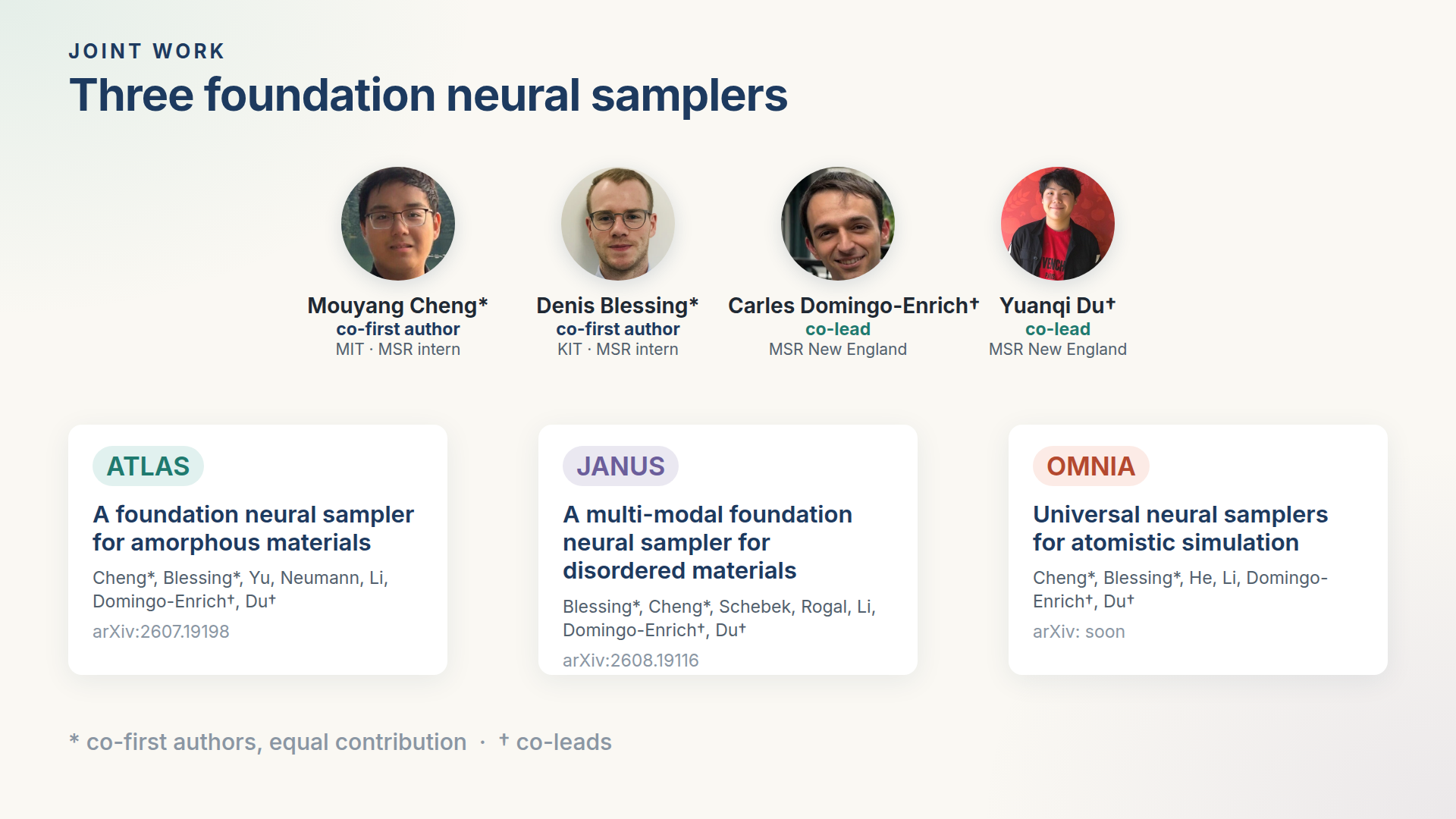
Led by Mouyang Cheng & Denis Blessing (equal contribution), co-led by @cdomingoenrich & me, with support from Mingda Li, @JiajunHe614, Botao Yu, Gerhard Neumann, Maximilian Schebek & Jutta Rogal 🤝 ATLAS: https://arxiv.org/abs/2607.19198 JANUS: https://arxiv.org/abs/2608.19116 OMNIA: coming soon
Yuanqi Du @YuanqiD
Why is this hard? Configurations follow p(x) ∝ exp(−U/k_BT), explored by local MD or Monte Carlo moves. A barrier ΔU costs ~exp(ΔU/k_BT) steps: in a glass or between phases the chain stays in one basin. ML potentials cut the cost per energy evaluation, not the number needed. ⏳
Yuanqi Du @YuanqiD
Neural samplers learn the sampler instead: a diffusion process from a simple prior to the Boltzmann distribution, trained from interatomic potentials. Samples are independent, one model spans many conditions, and path weights give unbiased ensemble observables and free energy. 🧠
Yuanqi Du @YuanqiD
ATLAS samples amorphous materials. One temperature-conditioned model generates a 2D glass former from the liquid down to the glass, while classical Monte Carlo struggles. Structure matches parallel tempering; the free energy is within 0.2% at >500× fewer evaluations. 🧊
Yuanqi Du @YuanqiD
ATLAS is amortized over composition: one 36 GPU-h pretraining instead of ~20 GPU-h per composition, ~300× less compute over 480 compositions. An LLM agent calls it as a tool and finds the stiffness–ductility Pareto front of high-entropy metallic glasses in 480 evaluations. 🤖
Yuanqi Du @YuanqiD
JANUS samples chemically disordered materials: discrete species per site plus continuous displacements and volume, sampled jointly by masked discrete + continuous diffusion, conditioned on T and Δμ. Free energy gives phase diagrams (Cu–Ag, Ni–Cr) at ~10³× fewer evaluations than MC. ⚖️
Yuanqi Du @YuanqiD
JANUS also runs grand-canonically on a lattice: 15 dopant elements and vacancies in Si and diamond. Motifs over-represented in 8,000 samples go to hybrid DFT: the Si E centre is recovered, and S–Ti (Si) and B–[O]–O (diamond) appear as new candidates with deep in-gap states. 💎
Yuanqi Du @YuanqiD
OMNIA goes off-lattice and opens up simulating surfaces: one model per metal, combined through free energy, gives H coverage on Pt(111) and Pd(111) at every T and μ_H. Pt saturates near a monolayer; Pd takes H below the surface, as in GCMC, at 7–11× fewer evaluations. ⚗️
Yuanqi Du @YuanqiD
Sodium in hard carbon, a sodium-ion battery anode. One OMNIA model is conditioned on the carbon framework: trained on 8,000 frameworks (1.0–2.0 g/cm³), tested on held-out ones. Bound Na peaks near 1.6 g/cm³ as in GCMC, at 38× fewer evaluations per framework. 🔋
Yuanqi Du @YuanqiD
No equilibrium data needed. The model proposes, the physics corrects: generate samples, label each with one force call, re-noise along an interpolant, regress the score on the force. The Boltzmann distribution is the fixed point; a replay buffer reuses every force call. 🔁
Yuanqi Du @YuanqiD
Each generated path carries a work: the log ratio of its forward and backward path densities, as in Jarzynski's equality. The resulting path weights fix the mass of each mode, give the free energy, and steer the sampler to a tilted target with SMC, no retraining. 🎯
Yuanqi Du @YuanqiD
OMNIA writes every ensemble in one form: canonical samplers at fixed volume, composition or atom number, weighted by their free energy. This covers NVT, NPT, ΔμNPT and μVT, on and off lattice. It pushes universal ML potentials to thermodynamics and autonomous materials discovery. 🚀