Pushing Probabilistic Machine Learning Out of Equilibrium
How out-of-equilibrium diffusion processes give us the most powerful generative models and inference algorithms in probabilistic ML today
Yuanqi Du
Microsoft Research
Joint work with
Jiajun He
Cambridge
Francisco Vargas
Cambridge · Xaira
Carles Domingo-Enrich
MSR New England
Eric Vanden-Eijnden
NYU · Capital Fund Mgmt
José Miguel Hernández-Lobato
Cambridge
Denis Blessing
KIT
Mouyang Cheng
MIT
and Zijing Ou, Yingzhen Li, Zongyu Guo, Yuanqing Wang, Paul Jeha, Peter Potaptchik, Leo Zhang, Saifuddin Syed, Dinghuai Zhang, Botao Yu, Gerhard Neumann, Mingda Li, Maximilian Schebek, Jutta Rogal, and many others
Roadmap
Today
1
The problem
samples, estimations, and why densities are expensive
2
Path space & physics
time reversal, the path weight, the work
3
Inference & training
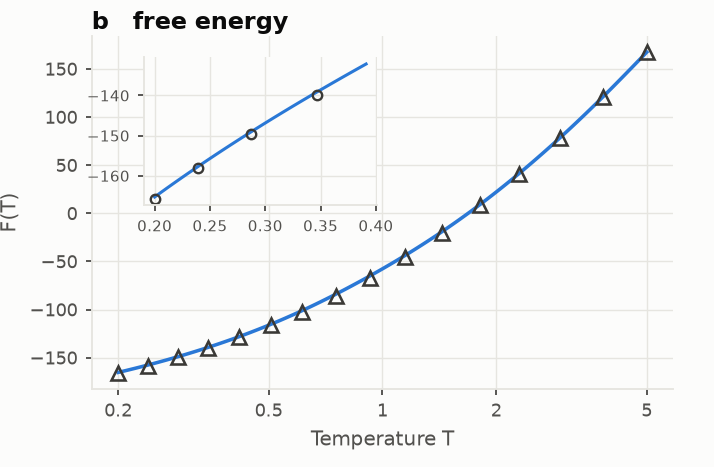
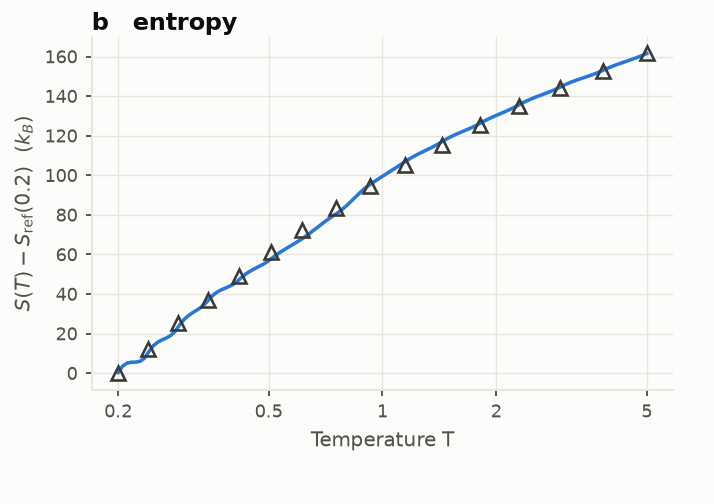
free energy, steering, learning from data or energy
4
Applications
ATLAS for glasses, JANUS for alloys and defects
5
Any state space
any Markov process: language models, whole paths
The problem · what we ask of models
We ask models for samples and estimations
Samples: a drug candidate, a conformation, a structure
Estimations: a free energy, a phase boundary, a rate
A learned model is always imperfect, so both need debiasing.
so the ODE $\dot x=\mu^+_t-\tfrac12\sigma_t^2\textcolor{#E76F51}{\nabla\log p_t}$ has the same marginals: flows and diffusions are equivalent up to the score.
Learning a diffusion (or a flow) = learning the score at every noise level.
Sohl-Dickstein et al. 2015 · Ho et al. 2020 · Song et al. 2021 · Nelson 1967, Anderson 1982 · Lipman et al. 2023, Albergo et al. 2023 (flow matching, interpolants)
Path space · the path weight
Path weights: time reversal is Bayes' rule in time
intractable marginals = a ratio of tractable kernels: one network call per step, no Jacobians
Path weight $\;w(X_{0:N})=\dfrac{\tilde\pi(X_N)\prod_t\Pb(X_t\mid X_{t+1})}{p_0(X_0)\prod_t\Pf(X_{t+1}\mid X_t)}\;$ computable for any model; $W=-\log w$ is the work.
He, Hernández-Lobato, Du†, Vargas†, ICLR 2026 (RNE) · Crooks 1999 · right: a real path of the toy sampler with its kernels
Path space · the physics
The path weight is the work
Jarzynski
$\mathbb E_{\Pf}\big[e^{-W}\big]=e^{-\Delta F}$
= annealed importance sampling
Crooks
$\dfrac{\dd\Pb}{\dd\Pf}=e^{-(W-\Delta F)}$
= time reversal
Second law
$\langle W\rangle\ge\Delta F$
= the ELBO
Zero variance $\iff$ reversible in finite time $\iff$ a perfect diffusion model.
Inference · the general recipe
One derivation, every estimator
what we want: an integral against $\tilde\pi=e^{-\beta U}$
$-\mathbb E_\pi\log p_\theta=\mathrm{KL}(\pi\,\|\,p_\theta)+{\rm const}$; the path KL equals $\mathcal L_{\rm DSM}$ with $\lambda_t=\sigma_t^2/2$, up to a $\theta$-free constant
Its minimizer is the score $\nabla\log p_t$: plain regression, so it scales.
But every label needs a clean sample $X_N\sim\pi$: exactly what we lack for a Boltzmann distribution.
Hyvärinen 2005 · Vincent 2011 (denoising score identity) · Ho et al. 2020 · Song et al. 2021 · Song, Durkan et al. 2021 (likelihood) · left: exact score of the noised mixture ($\alpha_t=1$)
Training · from energy
Without data: target score matching
Same noising kernel; integrate by parts to move the gradient onto the target:
Austin et al. 2021 · Sahoo et al. 2024 · Shi et al. 2024 · Ou et al. 2025 (masked diffusion) · Blessing*, Cheng*, …, Domingo-Enrich†, Du†, JANUS (2026) · animation: toy lattice
Applications · JANUS for discovery
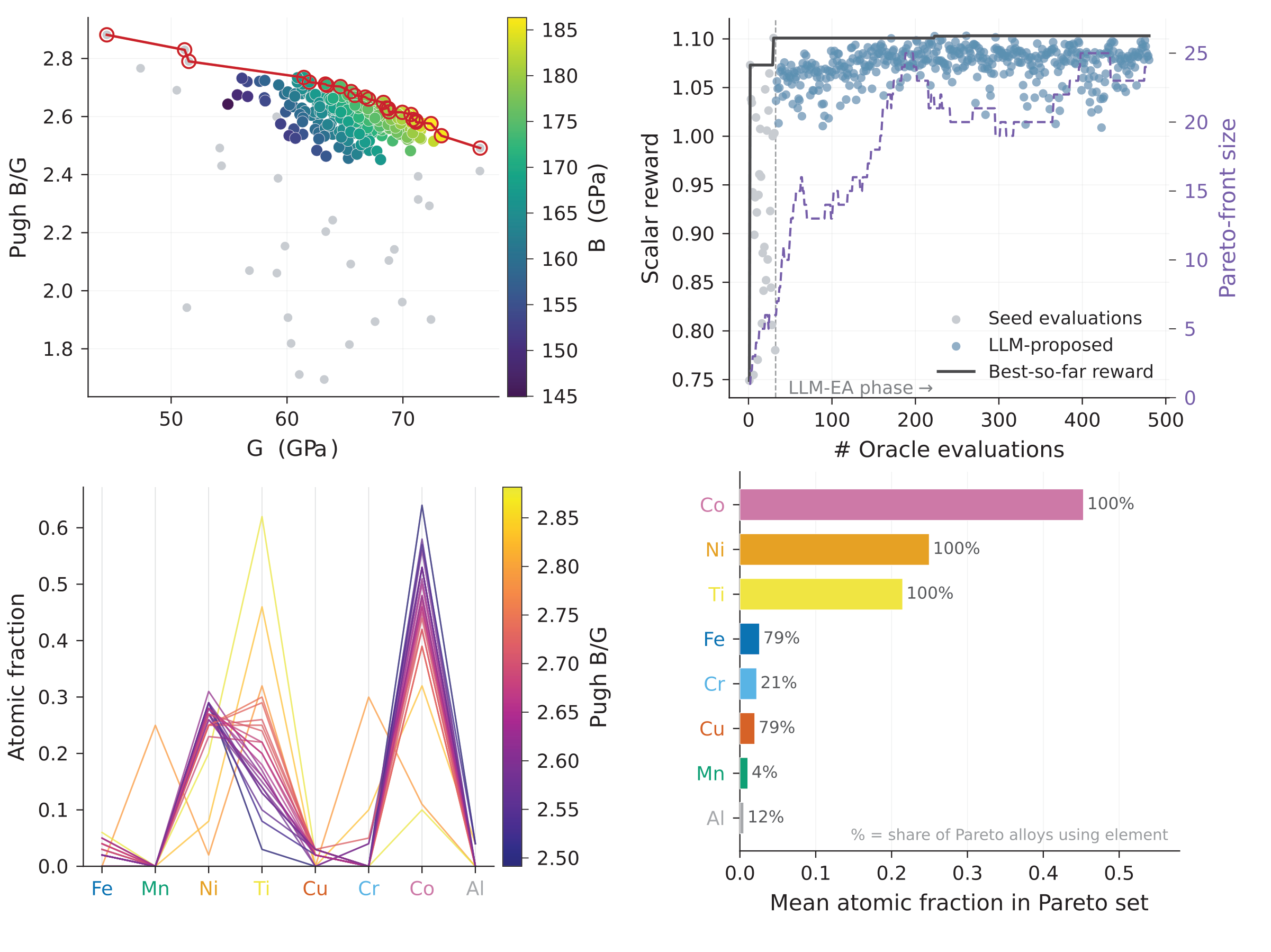
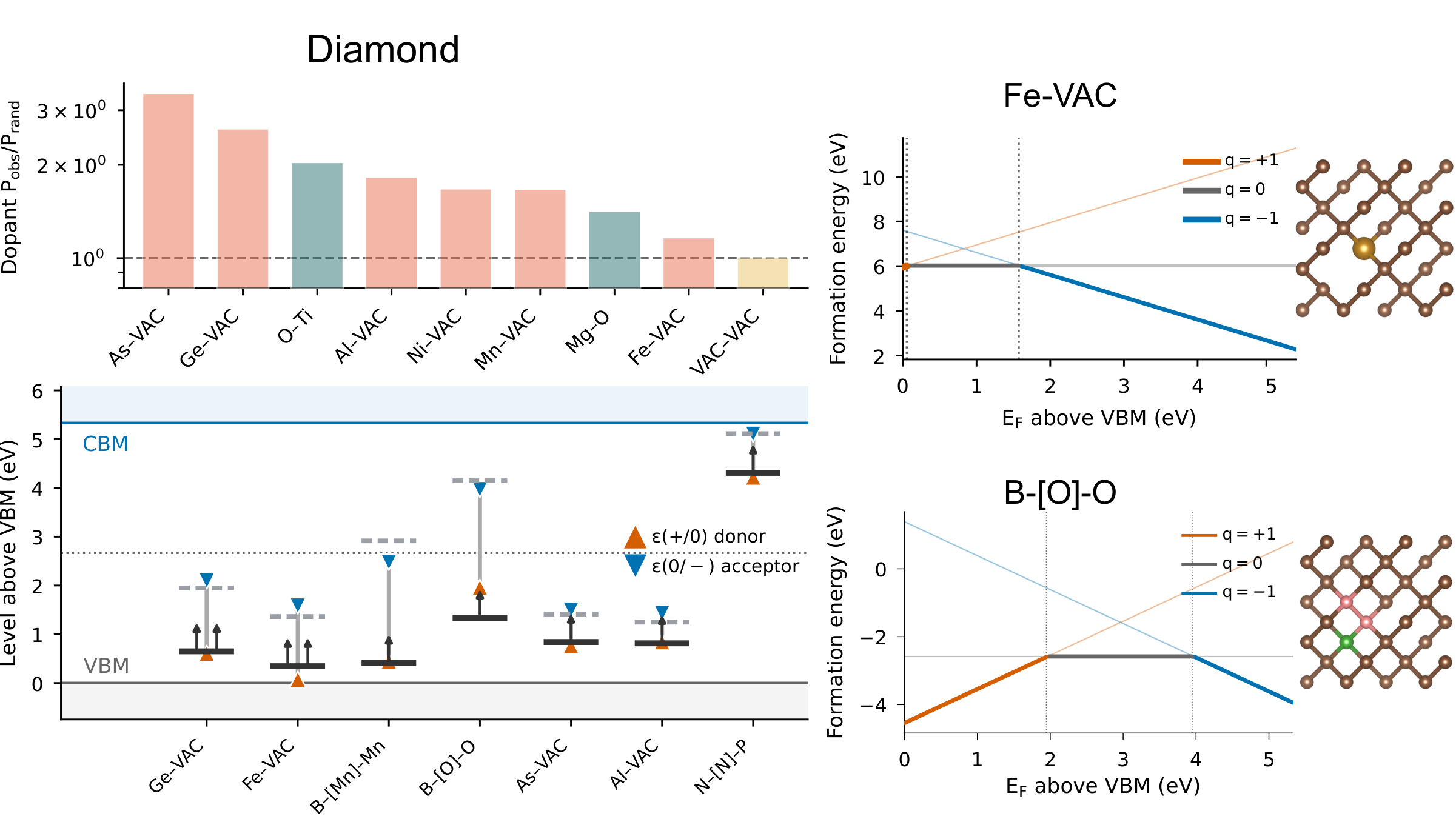
Discovery: defects for quantum technologies
Sampler: one grand-canonical model per host crystal; dopants and vacancies appear and disappear.
Screen: keep the defect motifs that appear more often than chance, then check them with DFT.
Found: known centres re-emerge (Si E centre, Ge–V); new: S–Ti (Si), B–O–O (diamond).
$\Pb_{i-1}=\dfrac{p_{i-1}\,\Pf_i}{p_i}=1$ (delete the last token)
So the path weight exact
$=\displaystyle\prod_i p(x_i\mid x_{\lt i})=p(x)$
Every tool here applies: steer to $p^\beta$, $p\,e^{r}$ or $p\,p'$ with SMC and replica exchange, and quality scales with inference compute, no reward model needed.
He, Guo, Hernández-Lobato, Du 2026 (Recipes for Steering and Scaling LLMs via Sampling)
Any state space · whole paths
Tilting whole paths: rare events and transitions
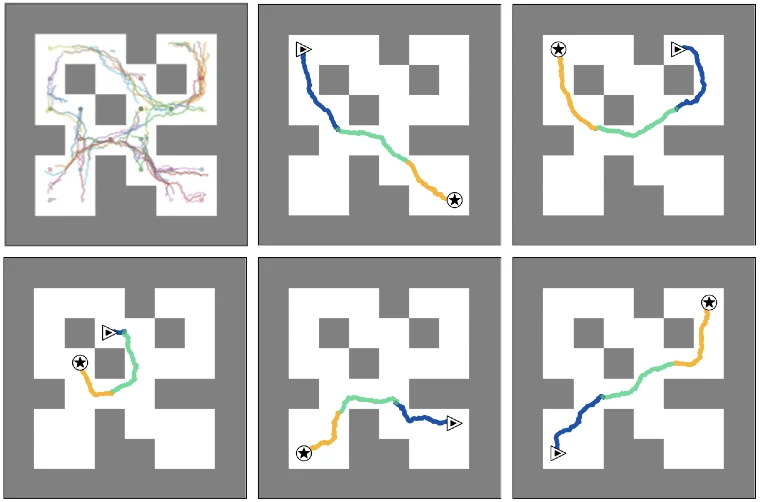
chignolin folding: a transition path sampled by stochastic optimal control
The path weight is the physical worknon-equilibrium thermodynamics: Jarzynski, Crooks, the second law
4
Training from data or from energylearn the time reversal: denoising, target score matching, the fixed-point loop
5
ApplicationsATLAS for glasses, JANUS for alloys and defects
6
Any state spaceany Markov process: language models; beyond endpoint marginals, whole paths
Equilibrium is exact only at infinite time. Out of equilibrium, every path carries its own correction.
Thank you!
Questions are very welcome.
Blog: Pushing Probabilistic Machine Learning Out of Equilibrium
RNE · FEAT · Free energy on any state space · CREPE · ATLAS · JANUS · LLM steering · Rare events via SOC
yuanqidu@microsoft.com · yuanqidu.github.io · @YuanqiD
Backup · training: related work
How do we train it? How the field got here
2018 · Boltzmann generators
A normalizing flow: exact likelihood $p_\theta(x)$, so reweighting to $\pi$ is exact.
But invertible layers limit expressiveness, and it is hard to scale to large, flexible systems.
The reverse KL is evaluated on paths sampled from the model itself; the log ratio is the path weight (from earlier). But: backprop through the solver, no reuse of energy calls, mode collapse.
2024 · PDDS → iDEM: the right idea
Regress the score on the model's own samples; iDEM adds the replay buffer. Each step closer to the final loop.
But the debiasing sits inside the label: SMC weights (PDDS), an importance-sampled score $\nabla\log\frac1K\sum_k e^{-\beta U(x+s_t\varepsilon_k)}$ (iDEM). High variance → fails at scale.
2025–26 · fixed-point matching
Same loop, but the label is one force $\beta\mathbf F(X_N)$ at the model's own endpoint: no weights inside the regression, simulation-free, replay buffer.
Regression shapes each mode; it does not fix the mode weights.
ATLAS · JANUS = fixed-point matching + the 2022–24 path weight loss, back as a regularizer for the mode weights.
Noé et al. 2018 (Boltzmann generators) · Zhang & Chen 2022 (PIS) · Vargas et al. 2023 (DDS) · Berner et al. 2024 (DIS) · Richter & Berner 2024 (log-variance) · Vargas et al. 2024 (CMCD) · Phillips et al. 2024 (PDDS) · Akhound-Sadegh et al. 2024 (iDEM) · He*, Du* et al. 2025 (No trick, no treat) · Havens et al. 2025 (Adjoint Sampling) · Liu et al. 2025 (ASBS) · Blessing et al. 2026 (Bridge Matching Sampler) · Havens et al. 2026 (Flow Sampling)